A receding hairline causes more bad haircuts than it needs to. Men try to hide it with length, comb it forward against its nature, or keep a style built for a hairline they had at twenty. The result usually draws the eye to exactly what they wanted to cover. In Waxhaw, barbers see the turnaround often: once a client stops fighting the hairline and chooses a shape that works with it, the recession becomes a minor feature instead of the headline. At Waxhaw Barber Styling Shop, that conversation is plain and practical, and it starts with a comparison of the genuine options.
There is no single right answer, because hairlines recede in different patterns and men value different things. Some want the lowest daily effort. Some want to keep length as long as it honestly works. Some reach the point where a very short cut is simply the cleanest look. The table below compares the main routes side by side so you can choose by pattern and priority.
Read your pattern before choosing
Most recession starts at the temples, deepening the corners while the center holds, or thins across the front in a more even retreat. Temple recession suits styles that keep the front short and controlled, because long fringe over deep corners separates and points at them. Even frontal thinning suits textured length worn forward in a short crop, which reduces scalp show-through by layering the hair over itself. A hairline that has retreated far, with thinning at the crown joining it, changes the calculation again. At that point, contrast is the enemy: long hair beside bare skin emphasizes both. Shorter and more uniform almost always reads stronger. Ask your barber to describe your pattern in plain words before discussing styles. Choosing for the pattern you have, rather than the one in a photo, is the entire strategy.
| Style route | Suits which pattern | Daily effort | When it stops working |
|---|---|---|---|
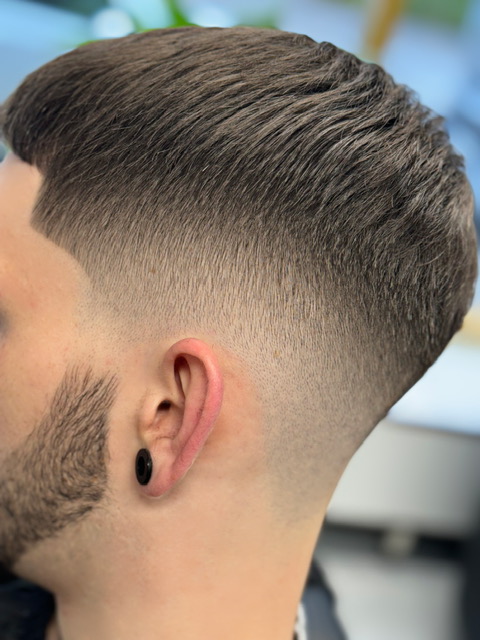
| Short textured crop, worn forward | Temple recession, early frontal thinning | Very low. Damp hands, optional matte product. | When the front thins too much to layer, fringe looks wispy instead of textured. |
| Buzz cut, one length or short fade | Advanced recession, recession plus crown thinning | Lowest. Nothing to style. | It rarely stops working. The limit is preference, not pattern. |
| Short sides, modest length on top | Mild temple recession with strong density on top | Low to moderate. Needs the top kept in proportion. | When top density drops, the contrast with the short sides starts to highlight thinning. |
| Classic taper with a neat side sweep | Mild, stable recession, conservative settings | Moderate. Daily combing into place. | When the sweep must cross bare temple to reach hair, it reads as a cover attempt. |
| Shaved head | Extensive loss, or men who prefer zero maintenance | Low, but frequent. Regular shaving and scalp sun care. | Head shape or scalp sensitivity may rule it out. Trial a buzz first. |
Texture, proportion, and the honest buzz
Two principles run through every row of that table. First, texture beats length. Choppy, layered texture on top breaks up light, hides scalp show-through, and keeps the front from forming a thin curtain. Second, proportion beats cover. Keeping the sides shorter than the top, and the top shorter than you wore it at twenty, restores balance as the hairline moves. The buzz cut deserves its honest mention here. For many men it is not a last resort but the best-looking option on the list: uniform, deliberate, and impossible to read as an accident. If you are curious, trial it in steps. Take the top down one stage per visit. Men who step down gradually usually know within two cuts whether the full buzz is their answer, without a single dramatic morning in front of the mirror.
What to stop doing
Stop growing the front long to sweep over the temples. Wind, humidity, and one hand through the hair undo it, and the gap it was hiding becomes the story. Stop parting further to the side each year to borrow hair from lower down; a migrating part is visible to everyone except its owner. Stop judging your hairline under the brightest bathroom light at six inches from the mirror, a view no one else ever gets. Judge it at arm's length, in daylight, after a proper cut in Waxhaw. And stop postponing the conversation. A barber who cuts your hair regularly has watched the pattern develop and usually has a next-stage plan ready. Asking early gets you a gradual, confident transition. Asking late gets you a rescue.
Common questions
Does cutting hair short make it grow back thicker?
No. Short cuts make hair look thicker by removing thin, tapered ends and reducing contrast, but the follicles produce the same hair. The improvement is visual, and it is real.
Should I grow my hair out to cover a receding hairline?
Almost never. Length used as cover separates, moves, and draws attention. Shorter, textured styles that accept the hairline look stronger in nearly every case.
When is a buzz cut the honest answer?
When the front and crown thinning meet, when fringe turns wispy at any length, or when you spend more time arranging cover than enjoying the cut. Try it in stages if you are unsure.
Photos in this guide are representative stock images.
← All guides from Waxhaw Barber Styling Shop← Back to Waxhaw Barber Styling Shop